
Hi! I am a postdoctoral researcher in the group of Michael Stumpf at the University of Melbourne. My research is on stochastic single-cell biology such as gene expression, cell proliferation, and Bayesian inference for single-cell data.
I completed my PhD at the University of Edinburgh under the supervision of Guido Sanguinetti and Ramon Grima. Prior to that, I was a research assistant in Jakob Macke’s research group, working on likelihood-free inference for biophysical models of neurons.
Research
Randomness is everywhere in biology, from individuals (what eye colour would my children have? could they inherit genetic diseases? ) to populations and ecosystems (how do species evolve or become extinct? ). Some of these can have significant impact on our lives, such as what are my chances of getting cancer? and when is the next pandemic going to happen?. I study the origins and consequences of noise at the level of cells and cell populations.
Randomness in cells
How does noise shape the behaviour of cells?
Gene expression, metabolism and cell signalling are all inherently stochastic. I use mathematical modelling to understand the role of noise in single-cell behaviour, and how it gives rise to the cell-to-cell variability we observe in biological experiments.
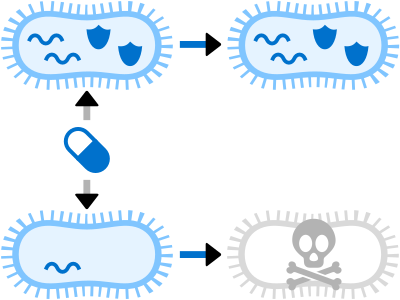 Identical cells respond differently to drugs — due to gene expression noise.
From cells to populations
How does the behaviour of individuals shape the fate of a population?
Cells are constantly subject to noise from within and from the environment. I combine ideas from statistical physics and population biology to understand how noise and the decisions made by individual cells impact population behaviour and survival.
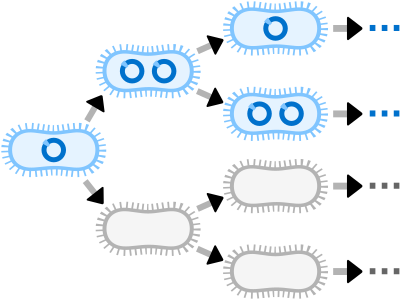 Cell-to-cell variability can have large-scale population effects.
Decoding single-cell data
What can experiments teach us about single-cell variability?
Understanding cell-to-cell variability requires observing individual cells, but single-cell measurements are often sparse, noisy and hard to interpret. I develop statistical and machine learning methods to turn such data into mechanistic insight.
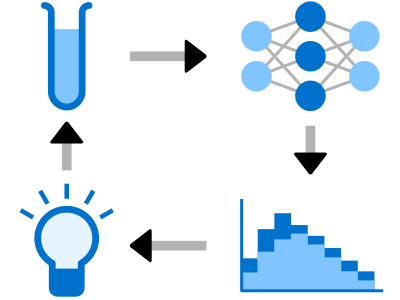 Extracting biological information from data requires new statistical tools.
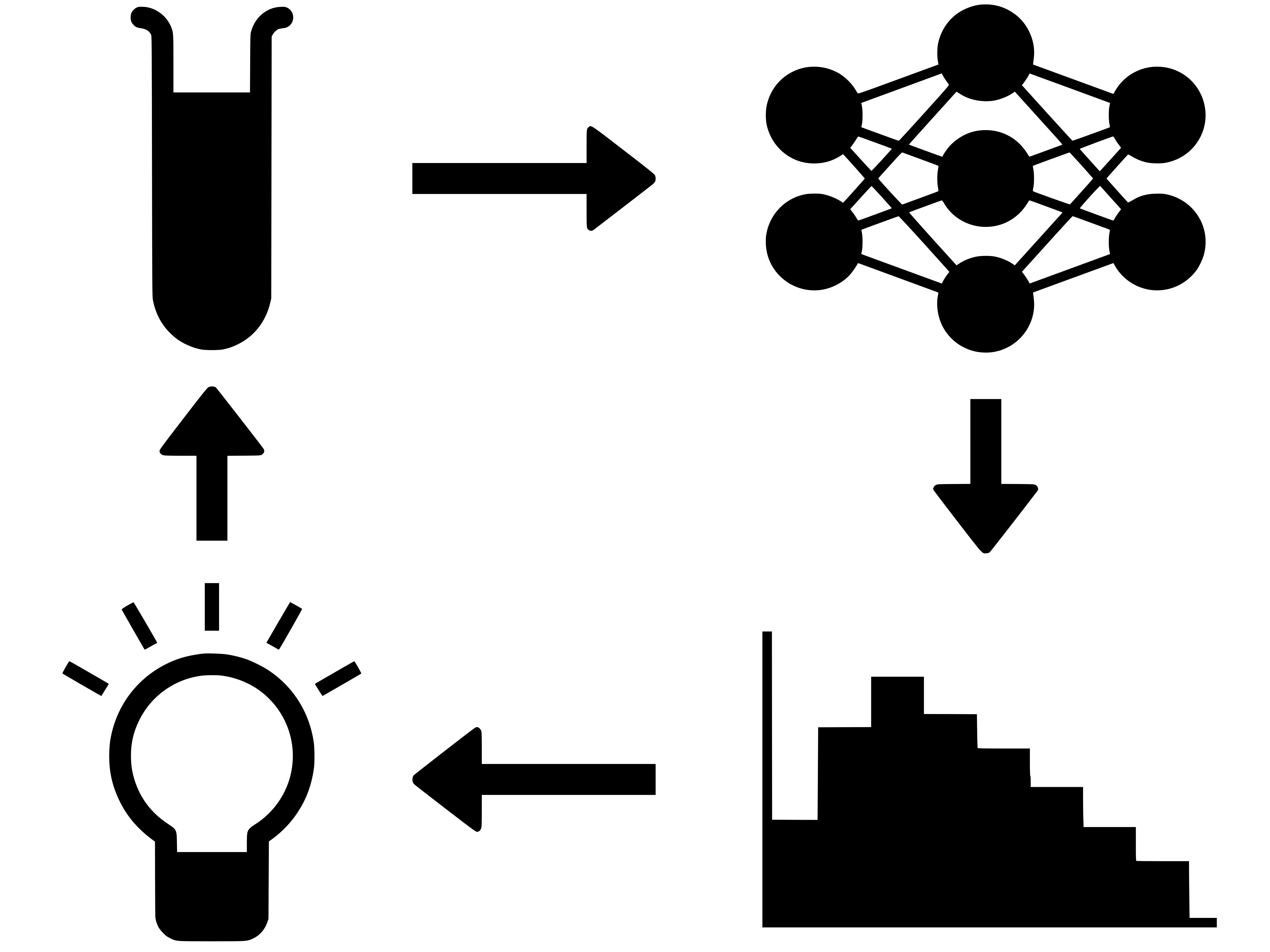
If you want to know more about my research, please get in touch!
Publications
Software
A lot of my research involves scientific programming, for which I use Julia, Python and Stan. All my code is on GitHub.
I welcome questions, issues and pull requests. All my code is intended to be freely used by others and is currently maintained. Apart from code the code linked in the above papers, I have written two Julia packages:
FiniteStateProjection.jl — Implements Finite State Projection algorithms to solve the Chemical Master Equation numerically. Part of Julia’s SciML ecosystem. Don’t forget to check out its sister package MomentClosure.jl, the original inspiration for this work!
Chemostats.jl — Efficient algorithms to simulate cell populations and estimate growth rates. This package, together with some of these algorithms in it, is currently in development.
Contact
You can contact me at firstname.lastname@unimelb.edu.au (lastname starts with an ‘o’). I am also active on GitHub. Feel free to get in touch if you have any questions concerning research, software or outreach.